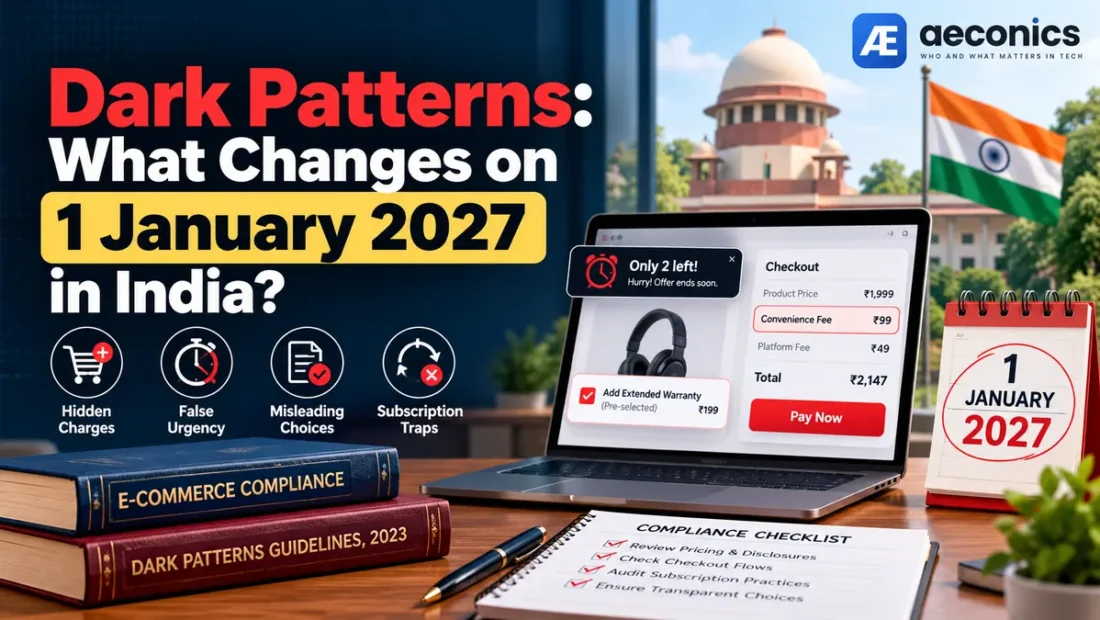
Dark Patterns: What Changes on 1 January 2027 in India?
What are dark patterns in digital marketing?
The 2023 Guidelines define them precisely. A dark pattern is:“any practices or deceptive design pattern using user interface or user experience interactions on any platform that is designed to mislead or trick users to do something they originally did not intend or want to do, by subverting or impairing the consumer autonomy, decision making or choice, amounting to misleading advertisement or unfair trade practice or violation of consumer rights” Guidelines for Prevention and Regulation of Dark Patterns, 2023, para 2(1)(e)They show up across the journey — checkout pages, pricing displays, subscription and renewal flows, consent interfaces, sponsored listings, product recommendations, and cancellation journeys. The line between persuasion and deception is accuracy. A genuine sale with a real end date is marketing. A countdown that resets on refresh is false urgency. Showing real stock levels is helpful. Claiming “only 2 left” regardless of inventory is not. The design, the accuracy, the context and the consent all matter — which is why the rules do not ban urgency, upsells or pop-ups outright.
What changes on 1 January 2027?
The amendment adds obligations across nine areas. Those most relevant to marketing and website teams are below.| Regulatory area | Existing position | From 1 January 2027 | Business action |
|---|---|---|---|
| Dark patterns | Prohibited under the 2023 Guidelines; no audit or display duty | Must comply with the 2023 Guidelines, undertake a yearly self-audit, and prominently display a certificate of compliance | Audit all journeys; document findings; prepare the certificate |
| Price reductions | No prescribed method for showing a discount | Where a price reduction is announced, both the reduced price and the prior price must be displayed. “Prior price” means the lowest price offered during the preceding 30 days | Rebuild discount display logic to track 30-day price history |
| Sponsored listings | General disclosure expectations | Sponsored listings must be identified through clear and prominent disclosures | Audit ad labelling across listings and recommendations |
| Search results | — | Entities shall not manipulate search results in a way that misleads users or adversely affects relevance to the query | Review ranking and personalisation logic |
| Consumer complaints | Grievance officer required | Every entity must give the complainant a copy of the complaint as recorded by its grievance officer | Update complaint-handling workflow |
| National Consumer Helpline | — | Every e-commerce entity must become a partner in the NCH convergence process | Begin NCH integration |
What the rule does not say
This matters as much as what it does say. Legal commentary on the notified text notes that the self-audit provision does not specify the audit methodology, scope, reporting format, or who is qualified to conduct it, and states no express consequence if a displayed certificate later proves inaccurate. Practical reading: you have latitude in how you audit, and no safe harbour in what you certify. At least one firm has observed that displaying a compliance certificate on a platform that still contains dark patterns could itself be treated as a false statement. Do not certify what you have not actually checked.Which businesses should review their websites?
Two separate instruments are in play, and they have different scopes. The 2023 Dark Patterns Guidelines apply, by their own terms (para 3), to all platforms systematically offering goods or services in India, to advertisers, and to sellers. Para 4 states plainly: “No person, including any platform, shall engage in any dark pattern practice.” That is broad — it is not limited to e-commerce entities. The amended E-Commerce Rules are narrower. The self-audit and certificate obligations attach to e-commerce entities as defined under the Consumer Protection (E-Commerce) Rules, 2020.- Marketplace e-commerce entities — platforms connecting buyers and third-party sellers. Carry the full set, including the marketplace-specific obligations above.
- Inventory e-commerce entities — those owning the inventory they sell. Covered by the e-commerce entity obligations.
- Businesses selling through their own online store — likely to fall within the e-commerce entity definition. Confirm your classification rather than assuming.
- Sellers on third-party marketplaces — the 2023 Guidelines apply to sellers directly. Note too that for content a seller or advertiser posts on a platform, the Guidelines place the duty to disclose that it is an advertisement on that seller or advertiser, not the platform.
- Agencies, UX consultants and developers — generally not the regulated e-commerce entity themselves, but you build the interfaces that create exposure for clients.
The 13 specified dark patterns
Annexure 1 of the 2023 Guidelines lists thirteen. The CCPA may specify others. Note the Guidelines’ own caveat: the listed practices and illustrations “provide only guidance and shall not be construed as an interpretation of law or as a binding opinion or decision as different facts or conditions may entail different interpretations.”| Pattern | What it is | Transparent alternative |
|---|---|---|
| 1. False urgency | Falsely stating urgency or scarcity, or showing false popularity. The Guidelines’ illustration: “Only 2 rooms left! 30 others are looking at this right now” without basis | Show real stock counts and real deadlines, or show nothing |
| 2. Basket sneaking | Adding items, services or donations at checkout without consent, raising the total payable | Nothing enters the cart unless the user put it there |
| 3. Confirm shaming | Using fear, shame, ridicule or guilt to nudge a purchase — e.g. “I will stay unsecured” | “No thanks” is a complete sentence |
| 4. Forced action | Requiring an unrelated purchase, signup or personal data to complete the intended purchase. Includes burying privacy settings | Ask only for what the transaction genuinely requires |
| 5. Subscription trap | Making cancellation impossible, complex or hidden; requiring payment details for a free subscription; ambiguous cancellation instructions | Cancel in as many clicks as it took to join |
| 6. Interface interference | Highlighting some information while obscuring other relevant information — pale “No” buttons, tiny cancel links, an “X” that opens an ad | Give both options equal visual weight |
| 7. Bait and switch | Advertising one outcome, delivering another — the cheap item becomes “unavailable” at payment, replaced by a pricier one | Only advertise what you can actually supply |
| 8. Drip pricing | Price elements not revealed upfront; charging more than shown at checkout; “free” without disclosing required purchases | Full price, including all charges, on the first price shown |
| 9. Disguised advertisement | Ads masked as user content or news, or blended into the interface to induce clicks | Label every paid placement clearly |
| 10. Nagging | Repeated, persistent requests — constant app-download prompts, or cookie banners with no “No” | Ask once; honour the answer |
| 11. Trick question | Confusing language or double negatives to misdirect — “Do you wish to opt out of updates forever?” answered “Yes, I would like updates” / “Not now” | Plain language; options that mean what they say |
| 12. SaaS billing | Recurring billing exploiting acquisition loops — no notice when a trial converts, silent auto-renewals, charging for unused features | Notify before every charge |
| 13. Rogue malwares | Ransomware or scareware convincing users of a non-existent virus to sell a fake removal tool | Not a marketing practice — a security issue |
Two exceptions worth knowing
Basket sneaking does not cover everything added to a cart. The Guidelines expressly exclude free samples, complimentary services, and “necessary fees” disclosed at the time of purchase — defined as fees necessary to complete the order, such as delivery charges, gift wrapping, or government taxes, where explicitly disclosed to the consumer at purchase. Marketplaces get limited relief on drip pricing. A marketplace e-commerce entity “shall not be liable for price fluctuations to the extent attributable to price changes by third party sellers or due to other factors beyond their control.”What digital marketing teams should change before the deadline
Pricing and promotions. The 30-day prior-price rule is the biggest engineering change here. If you announce discounts, you need systems recording price history and displaying the preceding 30-day low alongside the reduced price. Audit every urgency claim for factual basis, and check sponsored-listing labels are clear and prominent. Checkout and cart. Remove pre-ticked boxes. Confirm nothing is added without an affirmative action. Ensure the total, including all charges, appears before the final step rather than after. Subscriptions. Time your own cancellation flow. Count the clicks to subscribe, then to cancel. A large gap is the definition of a subscription trap. Check that free trials notify users before converting to paid. Consent and communication. Un-tick everything. Rewrite opt-outs in plain language. Note that consent is separately governed by the Digital Personal Data Protection Act, 2023 — overlapping, but a distinct regime requiring its own review. UX and CRO. Give accept and decline equal visual prominence. Check that every “X” closes what it appears to close. Review pop-up frequency and whether users can say no. None of this prevents effective conversion work. Clear pricing, honest scarcity and easy cancellation are compatible with persuasive design. Only the shortcuts go.Compliance checklist
Obligations confirmed by the rules (for e-commerce entities, from 1 January 2027):- Comply with the 2023 Dark Patterns Guidelines
- Undertake a yearly self-audit confirming the platform is free of dark patterns
- Prominently display a certificate of compliance
- Display both reduced price and 30-day lowest prior price on discounts
- Disclose sponsored listings clearly and prominently
- Avoid search-result manipulation that misleads or harms relevance
- Provide complainants a copy of their recorded complaint
- Partner in the NCH convergence process
- Inventory every website, app, landing page and campaign in scope
- Walk the full purchase journey as a new customer and record findings
- Test cancellation and refund journeys end to end
- Review consent and preference controls
- Assign a named owner and deadline to each issue found
- Keep dated evidence of what was reviewed, what was changed, and when
- Build a review step into the launch process for new campaigns and A/B tests
- Re-run the audit annually, in line with the yearly obligation
A practical roadmap before 1 January 2027
This sequencing is a suggested working method, not a process mandated by the rules.- Regulatory review. Confirm whether you are an e-commerce entity, and if so whether marketplace or inventory. Take legal advice on classification — the marketplace-specific obligations hinge on it.
- Interface audit. Walk every significant journey — homepage to checkout, subscription signup, cancellation, consent. Screenshot everything.
- Remediation. Assign owners. Prioritise pricing display and cancellation flows — they carry the most engineering work.
- Documentation. Record findings, fixes, test results and dates. If you must display a certificate, this is the evidence behind it.
- Ongoing monitoring. New campaigns can reintroduce problems. A team optimising aggressively can produce dark patterns nobody deliberately designed.
What happens if a business does not comply?
The 2023 Guidelines were issued by the Central Consumer Protection Authority under section 18 of the Consumer Protection Act, 2019. The amended E-Commerce Rules were notified under section 101(2)(zg) of the same Act. Enforcement therefore sits within the Consumer Protection Act framework, and the CCPA holds the relevant powers. The Guidelines state they are “in addition to and not in derogation of” other laws, so conduct may engage several regimes at once — including misleading-advertisement rules and the DPDP Act where consent design is involved. No specific penalty amounts are set out here. Consequences depend on the provision engaged, the conduct and the CCPA’s assessment. Anyone quoting a precise fine for a dark pattern breach is going beyond what the rules state. Take advice on your own exposure.How ethical UX and transparent marketing build customer trust
The commercial risk is more predictable than the regulatory one. Dark patterns work on the first transaction and fail on the second — a customer who finds a hidden fee at checkout, or spends twenty minutes cancelling, completes that purchase and does not return. Clear pricing, honest advertising, informed consent, accurate promotional claims and accessible cancellation all point the same way: the customer knows what they are agreeing to. That is what makes a second purchase possible, and repeat custom is where profitability usually sits. This is not a claim that compliance raises conversion rates — it may well lower them at the first step. The argument is about which customers you keep. If your conversion rate collapses once you show the full price upfront, the hidden fee was doing the selling.Frequently asked questions
What changes on 1 January 2027 regarding dark patterns in India?
The Consumer Protection (E-Commerce) (Amendment) Rules, 2026 take effect. E-commerce entities must comply with the 2023 Dark Patterns Guidelines, conduct a yearly self-audit, and prominently display a certificate of compliance. Obligations on pricing display, sponsored listings and search results also begin.What are the Indian dark patterns guidelines?
Guidelines issued by the CCPA under section 18 of the Consumer Protection Act, 2019, published in the Gazette on 30 November 2023. They prohibit dark patterns and specify thirteen in Annexure 1, with the CCPA able to specify others.Which ecommerce businesses need to prepare for the 2027 changes?
The self-audit and certificate duties apply to e-commerce entities as defined in the 2020 Rules, with some obligations specific to marketplaces. The 2023 Guidelines apply more broadly — all platforms systematically offering goods or services in India, plus advertisers and sellers.Will ecommerce platforms need to conduct annual dark pattern self-audits?
Yes. The amended rules require a yearly self-audit confirming the platform is free of dark patterns. They do not prescribe methodology, scope, format or who may conduct it — so you have latitude, but document what you did.What is a dark patterns compliance certificate?
A prominently displayed certificate confirming the self-audit is done and the platform is free of dark patterns. The rules do not prescribe format or placement. Only certify what you have genuinely verified — certifying a platform that still contains dark patterns carries its own risk.Which website practices should digital marketers review first?
Discount display first, since the 30-day prior-price rule needs development work. Then checkout — pre-ticked boxes and late fees. Then cancellation journeys. Those three carry the clearest obligations and the most common failures.Are all urgency messages, pop-ups and upsells prohibited?
No. The Guidelines target false urgency, not urgency itself — a real sale with a real deadline is fine. Necessary fees disclosed at purchase are expressly excluded from basket sneaking, as are free samples. The test is accuracy and genuine choice.Conclusion
The deadline is fixed: 1 January 2027. For e-commerce entities, dark pattern compliance becomes something you audit yearly, document, and display — alongside new duties on discount display, sponsored listings, search results and complaint handling. Most of the fixes are small: untick a box, show a fee earlier, rewrite a button, make cancellation findable. The 30-day price-history requirement is the exception and needs engineering time, so start there. This week: confirm whether you are an e-commerce entity, walk your own checkout as a new customer, and list what you find. Everything else follows from that list.Sources. Effective date and summary of amendments: Press Information Bureau, Ministry of Consumer Affairs, Food & Public Distribution, 10 September 2026, Release ID 294532. Dark pattern definitions, applicability, exceptions and the thirteen specified patterns: Guidelines for Prevention and Regulation of Dark Patterns, 2023, Gazette of India Extraordinary, Part III—Sec. 4, No. 783, 30 November 2023 (CG-DL-E-30112023-250339). The amendment is reported as G.S.R. 789(E) dated 9 September 2026, notified under section 101(2)(zg) of the Consumer Protection Act, 2019, with the dark patterns duty at Rule 4(15); those specific references and the observations about the rule’s silence on audit methodology come from legal commentary rather than from the gazette text, which I was unable to retrieve directly — verify against egazette.gov.in or the Department of Consumer Affairs before relying on exact wording.
Disclaimer. This article is for general information only and is not legal advice. Obligations depend on your specific business model and classification. Consult a qualified lawyer about your own position. Last reviewed: October 2026.

Lokesh Thalla
Lokesh Thalla is a contributor at Aeconics, covering technology, business, digital marketing, software, and the evolving digital world. His articles focus on making complex topics easier to understand through clear, practical, and research-driven content. At Aeconics, Lokesh writes about technology trends, online tools, business growth, digital marketing strategies, and useful how-to guides. His goal is to help readers stay informed, make better digital decisions, and understand the ideas shaping today’s connected world. Follow Lokesh Thalla on Aeconics for insightful updates, practical guides, and fresh perspectives on technology and business.