
Digital Marketing for Small Businesses: A 2026 Guide
Most small business owners in India are not short of marketing advice. They are short of a way to tell which advice is worth acting on. The honest answer in 2026 is that a lot of what worked three years ago no longer does, and the reason is that the search box people were optimising for has changed shape.
This guide covers what a small business should actually spend, where that money should go first, and what has genuinely changed this year. It replaces two older posts on this site that covered overlapping ground.
The one change that matters most in 2026
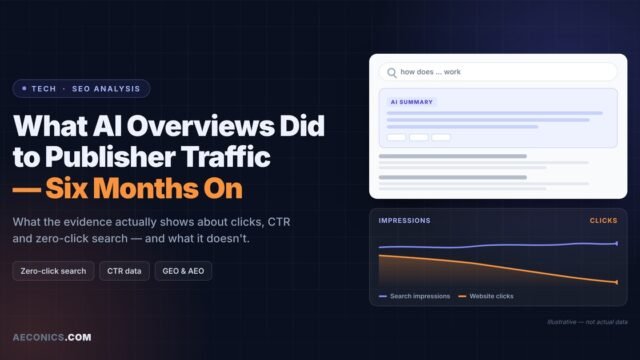
Google’s AI Overviews now answer a large share of queries directly on the results page. For businesses, this has a specific and measurable consequence: fewer people click through to websites.
The estimates vary widely depending on who is measuring. A randomised field experiment with 1,065 desktop Chrome users found organic clicks fell 39.8% when an AI Overview appeared. Chartbeat data put the drop in Google search traffic to publishers at roughly 33% globally in the year to November 2025. Pew Research found an average decline nearer 46%.
Those numbers describe publishers, not small businesses, and the gap matters. But the direction is the same for everyone: ranking at position one is no longer the same thing as getting the visit.
What this changes practically:
- Informational blog content has got harder. If your article explains what something is, an AI summary now does that above you, for free.
- Branded search has got more valuable. One vendor’s March 2026 data found branded queries with AI Overviews saw an 18% CTR increase. People searching your business name still click.
- Local search is comparatively protected. Someone searching “CA near me” or “web designer in Hyderabad” wants a place and a phone number, which a summary paragraph does not satisfy.
The strategic read: spend less on content designed to be found by strangers, and more on being findable by people who already have intent.
How much should a small business actually spend?
The widely cited benchmark, including from the US Small Business Administration, is 7–8% of gross annual revenue on marketing overall. Indian agency guidance typically lands in a 5–12% band, with newer businesses in competitive categories running higher.
In monthly rupee terms, published Indian agency figures cluster roughly like this:
| Monthly budget | What it realistically buys |
|---|---|
| ₹8,000 – ₹20,000 | One channel, done properly. Usually local SEO and Google Business Profile. |
| ₹25,000 – ₹40,000 | Website foundations plus organic, or one well-run paid channel. |
| ₹40,000 – ₹80,000 | Multi-channel, including ad spend. This is where most local businesses find a working mix. |
Two things these guides agree on, which is unusual enough to be worth noting:
Separate agency fees from ad spend. A quote of “₹30,000 a month” means nothing until you know how much of it reaches Google or Meta. Ask for the split in writing. Also confirm whether the 18% GST is included — many quoted prices exclude it.
Below about ₹40,000 a month, do not spread the budget. A ₹15,000 budget focused entirely on one well-chosen channel can produce real leads inside 60 days. The same ₹15,000 split across SEO, Instagram, Google Ads and email produces nothing measurable anywhere.
The order to spend in
Sequence matters more than channel selection, because each step makes the next one cheaper.
1. Foundations — before any spend
A site that loads fast on a mid-range Android phone over 4G. A phone number that is tappable. A WhatsApp link. Prices, or at least a price range. An address if you have premises.
Running ads to a site that fails any of these is buying traffic you have already decided to waste.
2. Google Business Profile — still the highest return in local
It is free, it appears above organic results, and AI Overviews have not displaced it for local intent. Complete every field, add real photographs rather than stock, and ask customers for reviews in person at the point they are happiest.
For a business serving a specific city or neighbourhood, this single asset often outperforms everything else combined.
3. One paid channel, properly measured
Pick the channel where your customers already are, not the one you find most interesting. Start at ₹5,000–₹15,000 a month, run it for at least eight weeks, and track cost per enquiry rather than impressions or reach.
If you cannot say what a lead costs you, you are not running a campaign. You are making donations.
4. WhatsApp — the channel most Indian SMBs underuse
It has the attention that email used to have. One practical caution from agencies running these campaigns: WhatsApp needs two to three cycles before you understand which message and offer actually gets a response. Judging it on a single send will mislead you.
5. Content — last, and only with an angle
Content still works, but generic content no longer does. What survives is material a summary cannot replace: your own pricing, your own case studies, photographs of your actual work, answers to the questions your customers ask on the phone.
What to stop doing
- Chasing follower counts. Followers are not customers. Enquiries are.
- Publishing weekly blog posts with nothing specific in them. This was weak advice in 2022 and it is actively wasteful now.
- Paying for a “digital marketing package” with no named deliverables. Ask what you receive each month and how it is measured. A vague answer is the answer.
- Buying bulk backlinks. Cheap link packages from unrelated sites are a liability, not an asset.
- Treating a DR score as proof of anything. Domain Rating is a third-party estimate, not a Google signal, and it is the easiest metric to manipulate.
How to tell if it is working
Three numbers, reviewed monthly:
- Cost per enquiry. Total spend divided by genuine enquiries. Not clicks. Not impressions.
- Enquiry-to-customer rate. If this is low, the problem is your sales follow-up, not your marketing.
- Where enquiries came from. Ask every caller. The answer is frequently not what your analytics claims.
Give any channel at least 90 days before judging it, and do not change three things at once — you will not know which one moved the number.
Frequently asked questions
How much should a small business in India spend on digital marketing per month?
Published Indian agency guidance clusters between ₹15,000 and ₹75,000 a month depending on sector and competition, with 5–12% of revenue as the common rule of thumb. Below roughly ₹40,000, put everything into one channel rather than splitting it.
Is SEO still worth it in 2026 with AI Overviews?
For local and branded search, yes — AI Overviews have displaced far less of that traffic. For general informational content, returns have fallen significantly. Research found AI Overviews appear on roughly 49% of technology queries, among the highest of any category.
Should I hire an agency or do it myself?
Below about ₹25,000 a month, agency fees consume most of the budget. Run Google Business Profile and one paid channel yourself first. Bring in help once you have enough spend that expertise pays for itself.
How long before digital marketing shows results?
Paid advertising can produce enquiries within days, though eight weeks is needed to optimise properly. Local SEO typically takes three to six months. Content SEO now takes longer than it used to and is less predictable.
The short version
Fix the website. Claim and complete the Google Business Profile. Pick one paid channel and measure cost per enquiry. Add WhatsApp. Only then write content, and only content that contains something nobody else can summarise.
Doing those five things in that order beats a larger budget spent in the wrong sequence, almost every time.
Budget ranges are compiled from Indian digital marketing agency pricing guides published in 2026 and are agency list prices rather than independent survey data. AI Overviews click-through figures come from a randomised Chrome field experiment (n=1,065), Chartbeat publisher data to November 2025, and Pew Research. Last reviewed: October 2026.

Lokesh Thalla
Lokesh Thalla is a contributor at Aeconics, covering technology, business, digital marketing, software, and the evolving digital world. His articles focus on making complex topics easier to understand through clear, practical, and research-driven content. At Aeconics, Lokesh writes about technology trends, online tools, business growth, digital marketing strategies, and useful how-to guides. His goal is to help readers stay informed, make better digital decisions, and understand the ideas shaping today’s connected world. Follow Lokesh Thalla on Aeconics for insightful updates, practical guides, and fresh perspectives on technology and business.
1 Comment