AI Tools Indian Small Businesses Are Actually Using
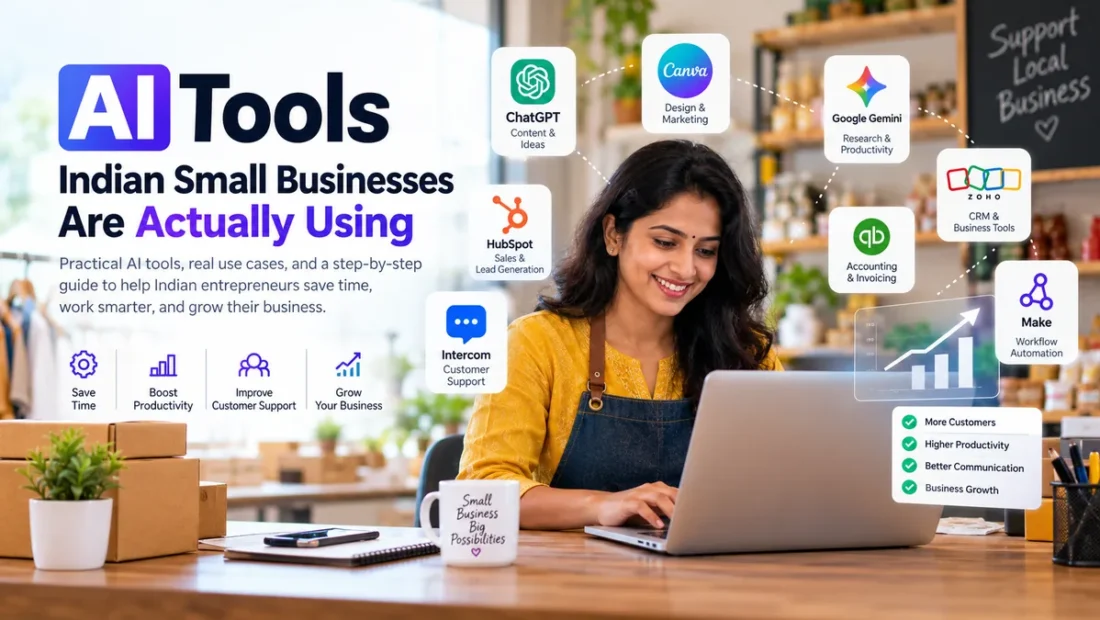
AI tools for small businesses in India are software that handle repetitive work — drafting marketing copy, answering routine customer questions, writing product descriptions, translating messages into regional languages — without you doing each one by hand. Most have a free tier, and most take an afternoon to learn.
The harder question is which ones are worth your time. Every AI company claims Indian businesses are adopting its product. Very little of that is backed by evidence you can check.
This guide covers what the research actually shows about AI adoption in India, which tools are genuinely useful for a small business or MSME, roughly what they cost, and how to test one properly in 30 days. Where a claim cannot be verified, it is labelled as such rather than presented as fact.
What the evidence actually shows about AI adoption in India
Start here, because this is where most articles on the subject go wrong.
Search interest has risen sharply
Kantar’s India in Search 2026 report, published in April 2026, found AI-related searches in India averaging 235 million per month, a 154% increase year on year. The report is based on Google search data from January to December 2025, analysed against Kantar’s own trend framework, and the AI category covers creation tools, transcription tools and what the report calls hyper-specific utilities.
What that figure does not tell you: it measures searches, not usage. It covers Indian consumers generally, not small businesses. Someone searching “what is ChatGPT” is counted the same as someone running their invoicing through an AI tool. Kantar has not published a full methodology for how queries were classified.
Rising search interest is a real signal of curiosity. It is not a measure of adoption, and anyone presenting it as one is overstating their case.
Actual MSME adoption is poorly measured
Here is the honest position: there is no reliable, current figure for what proportion of Indian MSMEs actually use AI tools. What exists is a mix of attitude surveys and dated adoption numbers.
| Source | Finding | What it measures |
|---|---|---|
| NASSCOM–Meta MSME study (2024) | 94% of tech-enabled MSMEs recognise AI’s ability to drive growth; 87% are confident in it | Attitude, not usage. The same study notes adoption remains limited |
| AIMO survey (2022) | Fewer than 15% of Indian MSMEs had adopted any AI or machine learning | Actual adoption — but four years old |
| Zoho survey (2025) | 60% of MSMEs plan to adopt AI/ML by 2030 | Intention, not usage |
| PwC, Unlocking the AI Edge for MSMEs (March 2026) | 87% expect productivity gains from greater AI use | Expectation, not usage |
| NASSCOM Voice AI Readiness (Oct 2026) | 31% at limited production, 13% at scaled deployment | Organisations generally, not MSMEs; voice AI only |
Why this matters to you: if someone tells you “most Indian small businesses are already using AI, you’re falling behind,” ask them for the source. The pressure is largely manufactured. You are not late.
Throughout this article, each tool is marked with whether documented Indian small-business adoption exists or whether it is simply a plausible use case. For most tools, it is the latter.
How Indian small businesses are using AI
Seven areas where AI genuinely helps a small business:
- Marketing and content. Social captions, festival campaign copy, blog drafts, email newsletters. The highest-volume use because the work is frequent and forgiving.
- Customer communication. Drafting replies, answering routine questions about timings, pricing and returns.
- Lead generation and sales. Follow-up drafting, enquiry sorting, basic CRM note-taking.
- Administration. Reading invoices, extracting data from documents, summarising long email threads.
- Ecommerce. Product descriptions and titles at volume, which is tedious by hand across hundreds of SKUs.
- Regional-language communication. Translating marketing material and customer messages into Hindi, Tamil, Telugu, Bengali and others. Arguably the most India-specific opportunity on this list.
- Workflow automation. Moving information between the apps you already use so nobody retypes it.
Notice what is missing: anything irreversible. AI should not be approving refunds, filing your GST return, or giving a customer a final answer on a complaint. More on that below.
AI tools for Indian entrepreneurs worth knowing about
Ten tools and categories. Pricing is given only where it could be verified; where it could not, that is stated rather than guessed.
1. General AI assistants — ChatGPT, Google Gemini, Microsoft Copilot
These three do substantially the same job — drafting emails and marketing copy, answering customer FAQs, summarising documents, thinking through a business problem. Pick one, not three.
Which one: choose by what you already use. On Google Workspace, Gemini sits inside Gmail, Docs and Sheets. Paying for Microsoft 365, Copilot works inside Word, Outlook and Excel — but it is no reason to switch to Microsoft if you are not already there. Otherwise ChatGPT is the most general-purpose starting point. All three have free tiers.
India pricing (ChatGPT, the only one I could verify): reported at ₹399/month (Go) and ₹1,999/month (Plus) including GST, with UPI accepted. The 12-month free Go offer for India ended on 21 January 2026. Pro pricing is quoted inconsistently across sources. These figures come from pricing-aggregator sites, not OpenAI’s own India page, which I could not load — verify before subscribing. Gemini and Copilot paid tiers vary by plan and region; check directly.
Watch out: all three state wrong things confidently. Never publish output on prices, dates, law or tax unchecked. Documented Indian SMB adoption: not independently established for any of them.
2. Canva — canva.com
For: social graphics, festival creatives, menus, price lists, pamphlets, basic video. Suits: retailers, restaurants, coaching centres, salons — any business needing visuals without a designer.
Cost: a genuinely usable free plan; AI features sit mostly on paid tiers with usage limits. Of everything here, this is the tool most likely to produce something usable on day one, because the templates do most of the work. Documented Indian SMB adoption: not independently established, though widely cited in Indian small-business discussion.
3. Bhashini — bhashini.gov.in
The most India-specific tool here, and the least known. Bhashini is the Government of India’s National Language Translation Mission under MeitY, covering the 22 scheduled languages with free developer APIs for translation and speech.
Suits: any business serving customers more comfortable in a regional language than English — outside metros, most of them.
Evidence of real use: unusually for this list, government deployment is documented. The Comptroller and Auditor General’s office launched CAG-BHASHINI Anuvaad for document translation in September 2026, notably keeping human review in the loop.
Limitations: built around government and developer use; the APIs may need developer help, and I found no clear commercial tier. Some sources describing free access are low-quality aggregator sites — verify terms on official MeitY or Bhashini pages. Documented adoption: government yes, small business no.
4. Zoho, including Zia — zoho.com
For: CRM, invoicing, books and helpdesk with AI assistance layered across them. Suits: small businesses wanting one connected system rather than six disconnected tools.
Why Indian businesses should look here first: Zoho is an Indian company — INR billing without forex friction, support in Indian time zones, products built around GST, and simpler data-residency answers. For a business nervous about where its customer data sits, that matters more than feature comparisons.
Cost: free tiers across several products; AI feature availability varies by plan. Documented Indian SMB adoption: Zoho publishes its own MSME research and has a substantial Indian customer base, but independent verification of AI-feature usage is not available.
5. AI customer support platforms
For: answering predictable questions automatically — order status, timings, return policy — and routing everything else to a person. Suits: businesses receiving the same ten questions daily.
Options include Zoho Desk, Freshdesk (Freshworks, also Indian) and Intercom; pricing and AI tiers differ substantially, so compare current plans directly. The rule that matters: make the handover to a human obvious and fast. A chatbot that traps a frustrated customer costs more than it saves.
6. Grammarly — grammarly.com
For: catching errors and adjusting tone in business emails, proposals and website copy. Suits: anyone writing to clients in English as a second or third language.
Cost: a free plan covers basic grammar and spelling, which is most of the benefit. Privacy note: it processes everything you type where it is active — do not run it on documents containing confidential client data without checking the terms.
7. AI-enabled accounting and invoicing
For: reading invoices, extracting totals and GSTINs, categorising expenses, flagging duplicates. Options with Indian GST support include Zoho Books, Vyapar and TallyPrime.
AI feature availability differs considerably between them and changes often — verify on the product’s own page what your plan includes. I have not independently tested any. The boundary: automate the extraction, not the filing. A person checks before anything is submitted.
8. AI video and design tools
For: short promotional clips, product demonstrations, Reels and Shorts. Suits: retail, food, fashion, real estate — anything where the product must be seen.
Honest caution: this category changes faster than any other and tools are discontinued regularly. Before paying annually, check the tool still exists and is actively developed. Start with Canva’s video features, which you may already have.
9. Automation platforms — zapier.com, make.com
For: connecting apps so information moves without retyping — a web enquiry creating a CRM record and sending a notification, for instance. Cost: limited free tiers; paid pricing is usage-based and in USD, so rupee cost moves with the exchange rate.
Reality check: most small businesses do not need this yet. Fix the task first; connect the systems later.
10. AI features inside tools you already pay for
The most overlooked option. Shopify, WooCommerce extensions, your email platform, accounting software and CRM have mostly added AI features already — often at no extra cost.
Before subscribing to anything new, spend thirty minutes checking what your existing subscriptions now include. Many businesses pay twice for the same capability.
Practical examples
The scenarios below are illustrative examples constructed to show how these tools fit real work. They are not case studies, and no revenue or growth figures are claimed.
- A clothing retailer in Surat photographs new stock, uses Canva templates to produce festival creatives in Hindi and English, and drafts captions with ChatGPT — replacing an agency retainer for routine posts.
- A digital marketing agency in Pune generates five ad copy variations per concept for client review instead of two, then edits the best by hand. The AI widens the options; the strategist still chooses.
- A coaching centre in Hyderabad publishes an AI-assisted FAQ covering fees, batch timings and syllabus, cutting the calls that interrupt teaching.
- An ecommerce seller with 400 SKUs drafts product descriptions in batches, reviewing each for specification errors before publishing.
- An independent consultant records client calls with consent, generates summaries, and uses them as the first draft of a proposal.
- A plumbing service auto-sorts WhatsApp enquiries by area and urgency, with the owner still deciding the schedule.
- A business serving Tamil-speaking customers translates its service catalogue and standard replies, keeping a fluent staff member to check anything customer-facing before it goes out.
In every one of these, a person reviews the output before a customer sees it. That is not a limitation of the examples — it is the design.
Affordable AI tools: what you can get free
| Tool | Primary use | Free option | Suitable business |
|---|---|---|---|
| ChatGPT | Writing, drafting, summarising | Yes, free tier | Any |
| Google Gemini | Writing, research, Workspace | Yes, free tier | Google Workspace users |
| Canva | Graphics, social, print | Yes — AI features mostly paid | Retail, food, services |
| Grammarly | Business writing | Yes — basics covered | Client-facing writing |
| Bhashini | Indian-language translation | Free APIs reported | Regional-language customers |
| Zoho | CRM, books, helpdesk | Free tiers on several products | MSMEs wanting one system |
| Zapier / Make | Connecting apps | Limited free tiers | Multi-tool businesses |
A realistic starting budget for a small Indian business is zero. Free tiers cover most of what a first experiment needs. Pay only when a specific limit is genuinely blocking you.
How to choose the right AI tool for your business
Score any candidate against these ten questions before paying for it.
- What specific problem does it solve? If you cannot name the task, you are shopping, not solving.
- How much time would it save weekly? Measure the task for a week first.
- What does it cost monthly — including GST, in rupees after conversion?
- How long to learn? Anything needing more than a few hours will not get used.
- Does it work with your existing apps?
- Is the output usable with light editing, or does fixing it take as long as writing it?
- Where does your data go? Check what is retained and whether it trains on your inputs.
- Does it handle your languages? Many tools are noticeably weaker in Indian languages.
- Can your staff actually use it?
- Can you measure the result?
You do not need a stack. One tool solving one real problem beats five subscriptions you log into twice.
How to start using AI in 30 days
Week 1 — Find the task and measure it
Log every repetitive task: how often, how many minutes each. Then pick the biggest time cost that is also predictable and forgiving — where a mistake is easy to catch and costs nothing.
Week 2 — Pick one tool and test it
Use a free tier. Run it on that one task only, keeping your current process going in parallel so nothing breaks. Save examples of good and bad output.
Week 3 — Review honestly
Against your Week 1 baseline, check: minutes saved per week, how much editing the output needed, whether customer turnaround improved, what staff actually think, and cost per task if you moved to a paid tier.
Week 4 — Decide
Three honest options: continue and build it into the routine, expand to a second task, or stop. Stopping is legitimate, and cheaper in week four than in month six. If you continue, write the process down so it survives the person who set it up.
Risks and mistakes to avoid
- Publishing without checking. AI states wrong facts confidently. Anything with a price, date, specification or legal claim needs verification.
- Entering confidential data. Customer records, financial details and contracts should not go into a free consumer tool whose retention terms you have not read.
- Trusting AI on tax, legal or financial questions. GST rules and compliance requirements change. Confirm with your CA or lawyer, not a chatbot.
- Automated replies with no escape route. Always give customers a fast path to a human.
- Subscribing before identifying the need. The most common waste. Start free, start with one task.
- Using AI images without checking rights. Generated images can resemble protected work. Read the licence terms, particularly for commercial use.
- Not measuring. Without a baseline you cannot tell whether a tool helped.
- Ignoring your obligations. India’s Digital Personal Data Protection Act, 2023 governs how you handle customer personal data, with provisions expected to be fully operational by May 2027. If AI tools touch customer data, this applies to you. Take professional advice on your specific position.
The single rule worth remembering: a person reviews anything a customer will see, and anything that cannot be reversed.
Frequently asked questions
What are the best AI tools for small businesses in India?
There is no single best. For writing, ChatGPT or Gemini; for visuals, Canva; for Indian-language translation, Bhashini; for connected CRM and invoicing, Zoho. The right first choice is whichever addresses your most frequent repetitive task — not whichever is most discussed.
Can Indian small businesses use AI tools for free?
Yes. ChatGPT, Gemini, Canva, Grammarly and several Zoho products all offer free tiers, and Bhashini’s APIs are reported as free. Free plans carry usage limits, but they are generally sufficient to test whether a tool helps before any money is spent.
How can AI help a small business increase productivity?
By removing repetitive work that follows predictable rules — drafting routine replies, producing social content, writing product descriptions at volume, extracting data from invoices. The gain is recovered hours for work needing judgement, not the replacement of staff.
Which AI tools are useful for Indian retailers and MSMEs?
Retailers typically get most from Canva for creatives and a writing tool for captions and descriptions. MSMEs with billing and customer management needs often find an integrated Indian platform such as Zoho more practical, since GST handling and INR billing are built in.
Is AI safe for small business customer data?
It depends entirely on the tool and how you use it. Read what each service retains and whether it trains on your inputs. Avoid putting customer records into free consumer tools. India’s DPDP Act, 2023 applies to how you handle personal data — seek professional advice on your obligations.
Can AI tools support Indian regional languages?
Partly. General tools handle major Indian languages with variable quality, usually weaker than their English output. Bhashini, the Government of India’s language platform, covers the 22 scheduled languages specifically. Always have a fluent speaker check customer-facing translations.
How should a small business measure return on AI investment?
Measure the task before you automate it — occurrences per month, minutes each, your hourly cost. Re-measure after 90 days and compare against the subscription cost plus the time spent managing the tool. If maintenance exceeds the saving, stop.
Conclusion
The useful truth about AI tools for small businesses in India is less dramatic than the marketing: a handful of free tools can remove several hours of repetitive work a week, and almost nothing else on offer is urgent.
Search interest has grown sharply — Kantar’s 154% figure is real — but it measures curiosity, not adoption, and no trustworthy current data shows how many Indian MSMEs genuinely use these tools. You are not behind.
The best AI tool is the one that solves a problem you actually have, at a price you can justify, with output you can trust after a quick check.
This week, do one thing: write down the task you repeat most often, pick one free tool that addresses it, and run both side by side for two weeks. Then look at the hours. That single experiment will tell you more about AI’s value to your business than any article, including this one.
Sources: Kantar India in Search 2026 (April 2026, based on Google search data January–December 2025); NASSCOM–Meta MSME study (2024); AIMO MSME survey (2022); Zoho MSME survey (2025); PwC Unlocking the AI Edge for MSMEs (March 2026); NASSCOM Voice AI Readiness (October 2026). ChatGPT India pricing is from pricing-aggregator sites, not OpenAI’s own India page, and should be verified before purchase. Bhashini access terms are described by secondary sources; confirm on official MeitY or Bhashini pages. No tool has been independently tested by the author, and no product is described as widely adopted by Indian small businesses without evidence. Business scenarios are illustrative, not case studies. This is general information, not legal, tax or financial advice. Last reviewed: October 2026.

Lokesh Thalla
Lokesh Thalla is a contributor at Aeconics, covering technology, business, digital marketing, software, and the evolving digital world. His articles focus on making complex topics easier to understand through clear, practical, and research-driven content. At Aeconics, Lokesh writes about technology trends, online tools, business growth, digital marketing strategies, and useful how-to guides. His goal is to help readers stay informed, make better digital decisions, and understand the ideas shaping today’s connected world. Follow Lokesh Thalla on Aeconics for insightful updates, practical guides, and fresh perspectives on technology and business.