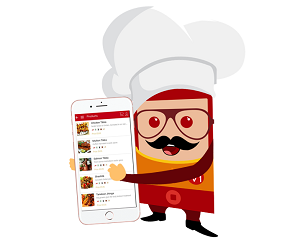
How Mobile Apps Can Be Helpful For Restaurants?
What you are actually paying the aggregators
The headline commission is not the number that matters.| Platform | Base commission | Effective take rate |
|---|---|---|
| Swiggy | 17 – 25% | 25 – 32% |
| Zomato | 18 – 28% | 26 – 35% |
| ONDC | 3 – 5% | 8 – 12% incl. logistics |
| Your own channel | 0% | Flat monthly fee + payment gateway |
The arithmetic, and its weak point
A vendor comparison puts the monthly channel cost of 100 orders a day at roughly ₹4.4–4.5 lakh through Swiggy or Zomato, against about ₹30,000 direct. A ₹4 lakh monthly difference is enormous, and it is also where you should slow down, because that calculation makes two assumptions it does not state. It assumes the orders transfer. They do not, automatically. The aggregators supply demand, not just delivery. A customer browsing Swiggy is choosing among restaurants; a customer opening your app has already chosen you. Those are different people in different moments. It excludes marketing and build cost. Getting a customer to download and reopen your app costs money every month, indefinitely. As one industry analysis puts it plainly: volume is everything. Order flow may matter more than a commission gap of a few percentage points — because 30% of something beats 100% of nothing.What a direct channel genuinely gets you
Margin on customers who already know you
This is the honest case. Regulars who order weekly and would order from you regardless are the orders worth moving. You are not acquiring them — you are declining to pay a finder’s fee on people who were never found.The customer data
Through an aggregator, the customer belongs to the platform. You cannot contact them, you do not know their order history, and you cannot bring them back when they stop ordering. ONDC is worth understanding here — commissions in the 3–8% range and you keep customer data. For many restaurants it is a better first step than building an app.Control over the experience
Your menu, your photographs, your pricing, no competitor advertising beside your listing, and no discount scheme imposed on you.Operational improvements that apply either way
Table reservations, pre-ordering for collection, digital menus, feedback capture before a bad review goes public. These are useful regardless of which channel the order came through.The sequence that actually works
Building an app first is the expensive mistake. Do it in this order:- Start with WhatsApp. Zero build cost. Many Indian restaurants take substantial direct volume this way. If customers will not order from you on WhatsApp, they will not download an app.
- Add a simple ordering website. No download required — the single largest barrier removed. Most ordering platforms provide this at a flat monthly fee.
- List on ONDC. Far lower commission than the aggregators, and you keep the customer data.
- Build an app only once direct orders justify it. If 30% of your volume is already direct, an app improves it. At 2%, it will not.
- Keep the aggregators for discovery. Treat their commission as a marketing cost for new customers, then move the repeat orders to your own channel.
How to move customers across
The mechanics, since this is where most attempts fail:- Put a card in every delivery bag with a real incentive. Not “follow us” — a specific discount on a direct order.
- Make the first direct order meaningfully cheaper. You have 25–35% of margin to work with; spending a third of it to acquire a direct customer pays back within three orders.
- Use a QR code on dine-in tables. Customers already in your restaurant are your cheapest direct-channel signups.
- Do not make them download anything first. Web ordering converts far better than an app install.
Frequently asked questions
What commission do Swiggy and Zomato charge in 2026?
Base commissions run roughly 17–25% for Swiggy and 18–28% for Zomato, but effective take rates reach 25–32% and 26–35% once payment fees, GST on commission, packaging and ad surcharges are included.Is building my own restaurant app worth it?
Only once you have meaningful direct order volume. An app does not create demand; it serves customers who already chose you. Start with WhatsApp ordering and a web ordering page, and build an app when direct orders justify the cost.What is ONDC and should restaurants use it?
ONDC is India’s open network for digital commerce. Reported commissions run 3–5%, or 8–12% including logistics, against 25–35% effective on the aggregators — and you keep customer data. For most restaurants it is a better first step than an app.Should I leave Swiggy and Zomato entirely?
Usually not. They supply discovery, which your own channel cannot. The workable model is aggregators for new customers and direct channels for repeat ones.The short version
Work out your actual effective take rate — not the commission you negotiated, the percentage that leaves your account. Then move your regulars to WhatsApp and web ordering, list on ONDC, and keep the aggregators for the customers who have not found you yet. The app comes last, if at all.Commission and cost figures are from Indian restaurant-technology vendors publishing in 2026. These companies sell direct-ordering software and their comparisons favour it — the ₹4.4 lakh vs ₹30,000 example in particular excludes marketing and build costs. Platform fee and CCI referral details are from industry reporting. Last reviewed: October 2026.

Lokesh Thalla
Lokesh Thalla is a contributor at Aeconics, covering technology, business, digital marketing, software, and the evolving digital world. His articles focus on making complex topics easier to understand through clear, practical, and research-driven content. At Aeconics, Lokesh writes about technology trends, online tools, business growth, digital marketing strategies, and useful how-to guides. His goal is to help readers stay informed, make better digital decisions, and understand the ideas shaping today’s connected world. Follow Lokesh Thalla on Aeconics for insightful updates, practical guides, and fresh perspectives on technology and business.