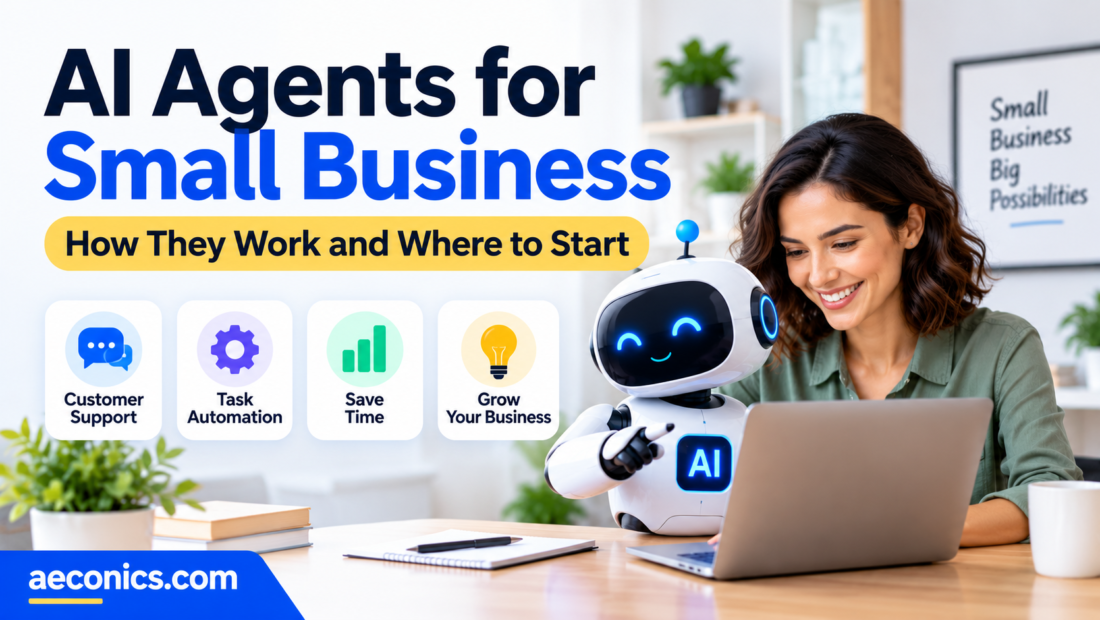
AI Agents for Small Business: How They Work and Where to Start
Artificial intelligence has moved beyond simple chatbots and text generators. One of the most interesting developments is the rise of AI agents—software systems designed to complete tasks, work through multiple steps and assist people with everyday business processes.
For small businesses, this could be particularly useful. A company does not necessarily need a large technology team to benefit from AI. With the right tools and a clear workflow, AI agents can help with customer enquiries, research, content creation, scheduling, sales follow-ups and other repetitive work.
What Is an AI Agent?
An AI agent is a software system that can receive a goal, analyse information, make decisions within defined limits and take actions to complete a task.
A traditional chatbot might answer:
“What are your business hours?”
An AI agent can potentially handle a larger workflow. It could collect a customer’s request, check available information, prepare a response and pass the enquiry to the appropriate employee.
The important difference is that an agent is designed around completing a task rather than simply producing a single response.
How Can Small Businesses Use AI Agents?
1. Customer Support
AI agents can help answer common questions about products, services, delivery, appointments and policies.
Businesses can use them to handle routine questions while employees focus on issues that require human attention.
2. Lead Follow-Ups
Sales teams often lose potential customers because enquiries are not followed up quickly.
An AI-assisted workflow can identify new enquiries, prepare personalised follow-up messages and remind sales staff when human action is required.
3. Market Research
Small businesses can spend hours collecting information about competitors, products and customers.
AI can help organise publicly available information and turn large amounts of research into easier-to-review summaries.
Human verification is still important, particularly when research will influence an important business decision.
4. Content Planning
AI agents can assist with content calendars, topic research, brief creation and repurposing.
For example, a business could turn one detailed article into:
- Social media ideas
- Email newsletter topics
- Short video concepts
- FAQ questions
- Additional blog topics
The business owner still controls the brand voice and final publishing decisions.
What Tasks Should Not Be Fully Automated?
AI agents are useful, but automation should have boundaries.
Businesses should be cautious when dealing with:
- Financial decisions
- Legal matters
- Sensitive customer information
- Employee decisions
- Medical information
- Important customer complaints
- Irreversible transactions
A good AI workflow should include human review where mistakes could cause significant harm.
How to Start With AI Agents
Start with one repetitive task.
Do not try to automate an entire business on day one.
First identify a process that:
- Happens frequently
- Has predictable steps
- Takes employees significant time
- Has clearly defined inputs and outputs
- Can be reviewed before an important action occurs
Then document the current process.
Once the workflow is clear, determine which parts can safely be assisted by AI.
AI Agent vs AI Chatbot
The terms are sometimes used interchangeably, but they describe different ideas.
A chatbot primarily focuses on conversation. An AI agent can be designed to complete a multi-step workflow.
For example, a chatbot might answer a question about an order.
An agent could potentially receive an order-related request, retrieve relevant information, identify the problem and prepare the next action.
The exact capabilities depend on the software and integrations being used.
Benefits for Small Businesses
AI agents may help businesses:
- Reduce repetitive administrative work
- Respond to customers faster
- Organise information
- Improve workflow consistency
- Support employees
- Create content more efficiently
- Handle larger volumes of routine requests
The biggest opportunity is not replacing every employee. It is removing unnecessary repetitive work so people can spend more time on tasks requiring judgement, creativity and relationships.
Final Thoughts
AI agents are becoming an important part of modern business software. Small companies do not need to automate everything to benefit from the technology.
The practical approach is to start with one repetitive workflow, establish clear boundaries and measure the results.
AI should support the people running a business—not remove the human judgement that makes the business valuable.

Lokesh Thalla
Lokesh Thalla is a contributor at Aeconics, covering technology, business, digital marketing, software, and the evolving digital world. His articles focus on making complex topics easier to understand through clear, practical, and research-driven content. At Aeconics, Lokesh writes about technology trends, online tools, business growth, digital marketing strategies, and useful how-to guides. His goal is to help readers stay informed, make better digital decisions, and understand the ideas shaping today’s connected world. Follow Lokesh Thalla on Aeconics for insightful updates, practical guides, and fresh perspectives on technology and business.