What AI Overviews Did to Publisher Traffic — Six Months On
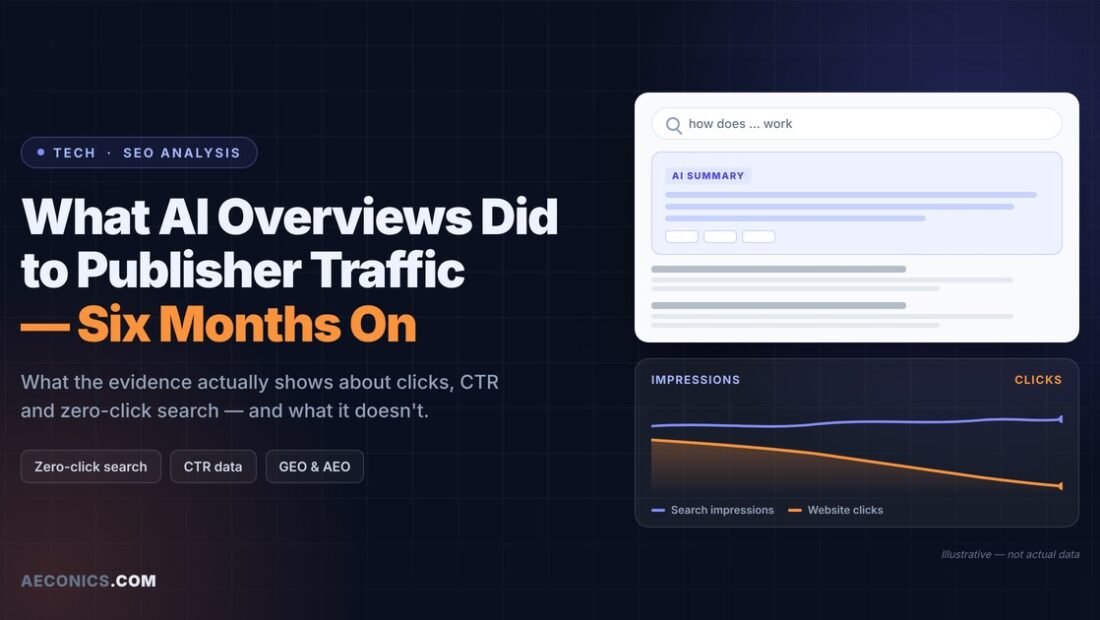
On 5 May 2026, Google announced a set of changes to AI Overviews aimed squarely at one complaint: publishers were not getting clicks. The update added a “Further Exploration” section of curated links at the end of AI Overviews, labelled links from publications a user already subscribes to, and showed site names when you hover over a citation on desktop. Google said early testing made users “significantly more likely” to click.
Six months have passed. This article asks a narrow, answerable question: what does the evidence actually show about publisher traffic in that window, and how much of it can honestly be pinned on AI Overviews?
The short version is that the declines are real, large, and well documented — but the story underneath them is messier than most headlines suggest, and the parts that are messy are the parts publishers most need to understand.
Quick answer: what did AI Overviews do to publisher traffic?
Evidence through late 2026 shows substantial declines in Google search referrals to publishers — Chartbeat recorded a 40.2% year-on-year fall to July 2026 — and a randomised experiment found AI Overviews causally reduce outbound organic clicks by 39.8%. But AI Overviews are not the sole cause. Hard news queries rarely trigger them, Discover referrals fell independently, and loyal-audience traffic held steady. Impact varies sharply by publisher size and query type.
What Are Google AI Overviews?
AI Overviews are AI-generated summaries that appear at the top of some Google search results, above the traditional blue links. They synthesise information from multiple web pages into a short answer, with citation links to the sources used.
Three distinctions matter:
- Versus organic listings. A traditional result is a link with a title and snippet; the user must click to get the answer. An AI Overview delivers the answer on the results page, with links positioned as optional supporting references.
- Versus featured snippets. A featured snippet extracts text from one page and attributes it to that page. An AI Overview generates new text from several sources, so no single publisher owns the wording.
- Versus AI Mode. AI Overviews appear within standard search results. AI Mode is a separate conversational search experience the user chooses to enter, with follow-up questions and a chat-style interface. They behave differently and should be measured separately.
Scale matters when reading any study. The Reuters Institute reported in January 2026 that AI Overviews appeared on roughly 10% of US search results, with AI Mode available in 120 markets. A 40% click reduction on 10% of queries is a very different business problem from a 40% reduction across the board.
Why the Six-Month Mark Matters
Six months is long enough to distinguish a trend from a fluctuation, and short enough that the market conditions haven’t entirely changed underneath you.
It also brackets a specific, verifiable event. Google’s May 2026 publisher-links update was an explicit attempt to send more traffic to sources. Measuring the period after it tells you something the earlier data could not: whether design changes materially altered the outcome.
Some measurement cautions worth holding onto:
- A single month proves nothing. Search demand is seasonal, news cycles are lumpy, and core updates land unpredictably.
- Year-over-year beats month-over-month for the same reason — though if the previous year was also affected, a flat year-on-year number can conceal a two-year collapse.
- Rollout timing differs by market. US data and Indian or European data are not interchangeable.
- Industry averages hide enormous variance. Your own Search Console data is more relevant to your business than any aggregate.
The period this article covers: primarily May to October 2026, drawing on data collected between November 2024 and July 2026. Where a study predates that window, the date is stated so you can weigh it accordingly.
What Happened to Publisher Traffic?
Here is the strongest available evidence, with its limits attached.
| Study / source | Measurement period | Geography / sample | Main finding | Important limitation |
|---|---|---|---|---|
| Agarwal (ISB) & Sen (CMU), SSRN — posted 3 Apr 2026, revised 17 Jun 2026 | 7 Jan – 10 Feb 2026 | US; 1,065 desktop Chrome users, ~68,000 searches | Showing an AI Overview cut outbound organic clicks 39.8% and raised zero-click searches 34.5%. Sponsored clicks flat. | Randomised, so causal — but desktop-only, Prolific-recruited panel. Does not measure publisher revenue. AI Mode arm exploratory due to attrition. |
| Chartbeat, 2026 Publisher Playbook | July 2025 – July 2026 (YoY) | Chartbeat publisher network, mostly news/media; no country split | Google Search referrals down 40.2% YoY (vs 21.9% the prior year). Discover down 34.3%. Search share of pageviews fell from ~9% (Jul 2024) to ~5% (Jul 2026). | Does not isolate AI Overviews from ranking or Discover changes. Sample composition may differ between periods. Chartbeat sells analytics to publishers. |
| Chartbeat, via Reuters Institute (12 Jan 2026) | Nov 2024 – Nov 2025 | 2,576 sites worldwide (797 US, 1,031 European) | Google organic search traffic down 33% globally; down 38% in the US. | Report states explicitly it does not establish how much is caused by AI Overviews. |
| Chartbeat, via Axios (17 Mar 2026) | Two years to end-2025 | Thousands of global Chartbeat client sites | Search referrals down 60% for small publishers (1k–10k daily views), 47% medium, 22% large. | Axios attributes part of the overall 6% pageview drop to non-search factors (non-election year, news cycle). |
| Ahrefs (Feb 2026) | Not stated in secondary reporting | Large keyword sample | AI Overviews correlate with a 58% CTR reduction for top-ranking pages — nearly double the 34.5% Ahrefs found in April 2025. | Correlational, not causal. Verify methodology against Ahrefs’ original publication before citing. |
| Pew Research Center (22 Jul 2025) | Browsing Mar 2025; results scraped Apr 2025 | US; 900 adults, 68,879 searches | Users clicked a result in 8% of visits with an AI summary vs 15% without. Only 1% clicked a link inside the summary. | Predates the window. Google disputed the methodology, citing overlap with unrelated algorithm testing. |
| SparkToro / Similarweb (2026) | Jan – Apr 2026 | US clickstream panel, desktop + mobile web | 68.01% of Google searches ended without a click, up from 60.45% in 2024. | Panels differ year to year (“apples and oranges,” per the authors). Excludes the Google mobile app, likely understating the true rate. |
| Reuters Institute predictions survey (12 Jan 2026) | Fieldwork 18 Nov – 20 Dec 2025 | 280 digital leaders, 51 countries | Publishers expect search traffic to fall ~43% over three years; ~20% expect losses above 75%. | Expectations, not measurements. Strategic rather than representative sample. |
Google’s position differs. In August 2025, Google’s Liz Reid wrote that “total organic click volume from Google Search to websites has been relatively stable year-over-year,” and Google has said AI Overview clicks are higher quality because users spend longer on the destination. Google published no supporting data alongside that claim — no figures, no chart, no Search Console aggregate — which is why the industry has largely set it aside. It should still be recorded as the platform’s stated position.
Which Types of Publishers Are Most Exposed?
Informational Blogs
Documented risk. Definitions, how-to queries and general-knowledge questions are exactly what AI Overviews summarise well. Pew and Ahrefs both found the steepest CTR reductions on informational queries. If a page’s entire value is a fact a model can restate in two sentences, the click is genuinely at risk.
News Publishers
Mixed, and more nuanced than the headlines. Chartbeat’s news-heavy network recorded a 40.2% YoY search decline — but the Reuters Institute noted that hard news queries have been largely exempt from AI Overviews, with lifestyle and utility content (weather, TV guides, horoscopes) hit harder. That matters: it means much of the news decline is attributable to something other than AI Overviews, including Discover changes, ranking shifts and a quieter news cycle.
Affiliate and Product Review Websites
Plausible risk, partially offset. Comparison and buying-guide queries are summarisable. Google’s May 2026 update added more product review cards and comparison features with direct links to retailer and review sites, which may route some traffic back. Amsive has reported branded queries with AI Overviews seeing CTR increases, suggesting generic “best X” pages are more exposed than brand-plus-category pages.
Health, Finance, and Professional Information Websites
Insufficient sector-specific evidence. These are high-stakes categories where Google applies stricter quality thresholds, and no reliable study isolates their performance over this window. Anyone claiming a precise YMYL figure is extrapolating. Treat accurate sourcing and identifiable expertise as baseline quality practice rather than a traffic tactic.
Local and Service-Based Websites
Largely a different surface. Local discovery runs mainly through Maps, local packs and business profiles rather than AI Overviews. Effects exist but vary heavily by query, and the aggregate publisher studies above do not measure them.
Why AI Overviews May Reduce Organic Clicks
Several mechanisms plausibly contribute. Only the first has been tested causally.
- The answer is sufficient. The user has what they came for and stops. This is the mechanism the randomised experiment supports.
- Position displacement. Advanced Web Ranking has found the first organic result can sit roughly 1,674 pixels down the page when an AI Overview is present. A link nobody scrolls to is a link nobody clicks.
- Reframed citations. Links inside an overview read as footnotes rather than destinations. Pew measured clicks on them at 1% of visits.
- Intent split. Informational queries are more summarisable than transactional ones, where the user still needs to reach a product, booking or tool.
- Query wording. Whether an overview triggers at all depends heavily on phrasing, which is why two similar keywords can behave completely differently.
A useful finding from the randomised study, often missed: removing AI Overviews produced no measurable difference in click quality — bounce rate, back-button use, time on page — which the authors describe as precisely estimated nulls. That is evidence against the “fewer but better clicks” framing.
The Zero-Click Search Problem
A zero-click search is one where the user gets what they need without visiting any website — because the answer appeared on the results page, or they refined their search, or they simply left.
This predates AI Overviews by a decade. SparkToro’s series puts US zero-click at roughly 45% in 2016, 49% in 2019, 60.45% in 2024 and 68.01% in early 2026. AI features accelerated an existing trend rather than inventing one.
Two qualifications. Zero-click isn’t automatically lost revenue — a user who reads your brand name in an overview and later searches for you directly is a delayed gain that no referral report captures. But for businesses whose model is advertising impressions or affiliate clicks, a visit that never happens is revenue that never happens, and the delayed-brand-benefit argument shouldn’t be used to wave that away.
Are All Publishers Losing Traffic?
No — and the exceptions are instructive.
Chartbeat’s 2026 data contains a detail worth more than most of the decline figures: loyal readers held steady. Visitors who returned on at least eight of the last sixteen days did not drop, which Chartbeat identifies as the main reason total pageviews fell only slightly (around 31.1 billion a month across January–July 2026, versus about 32 billion in 2025) despite search collapsing. New readers fell 14% and returning readers 8%. The audience you already own was insulated. The audience search used to introduce you to was not.
Characteristics that appear to confer some protection — none guaranteed, all worth testing against your own data:
- Brand and navigational demand. People searching for you by name still arrive. Axios linked large publishers’ milder 22% decline to brand recognition and direct products.
- Original reporting and proprietary data that cannot be synthesised from existing pages.
- Transactional intent — buying, booking, applying — where a summary cannot complete the task.
- Tools, calculators, templates, communities and anything interactive. The answer isn’t text.
- Depth beyond a summary, where a 169-word overview genuinely cannot substitute.
One thing the data does not support: that AI chatbots are picking up the slack. Chartbeat put AI referrals at 0.01% of traffic in its 2026 playbook and found they declined across five providers during 2026; Axios reported under 1% in March 2026. The Reuters Institute estimated Google sends roughly 500 times more referrals than ChatGPT from search alone. Optimising for chatbot referral traffic as a replacement channel is not currently supported by the numbers.
How Publishers Can Measure the Impact
- Set a baseline from a comparable pre-change period — ideally the same months a year earlier.
- Compare clicks, impressions, CTR and average position in Search Console. Falling CTR at stable impressions and position points toward a results-page change; falling impressions points toward rankings.
- Segment by content type and intent — informational, commercial, navigational, transactional. Aggregate numbers will mislead you.
- Analyse query groups rather than individual keywords, so you can see patterns.
- Run year-over-year comparisons to strip out seasonality.
- Follow it through to GA4: landing-page sessions, engagement, conversions and revenue.
- Check for confounders — core updates, redesigns, migrations, lost backlinks, new competitors.
- Keep a dated log of Google rollouts and your own site changes.
- Track continuously. Do not restructure a content strategy around three bad weeks.
An honest limitation: Search Console does not segment impressions or clicks by whether an AI Overview appeared. You cannot directly attribute a change to AI Overviews using standard reports alone. What you can do is build a strong circumstantial case — CTR falling on query groups known to trigger overviews while position holds — and treat it as evidence, not proof.
| Metric | What to monitor | Why it matters |
|---|---|---|
| Organic clicks | Changes by page and query | Measures visits generated from search |
| Impressions | Changes for relevant queries | Helps identify shifts in search visibility |
| CTR | Clicks relative to impressions | Shows whether impressions are translating into visits |
| Average position | Ranking changes over time | Helps separate ranking effects from other changes |
| Organic sessions | Landing-page traffic in GA4 | Measures visits reaching the website |
| Conversions | Leads, sales, sign-ups, subscriptions | Connects traffic to business outcomes |
| Revenue per session | Revenue generated by organic visits | Helps evaluate commercial impact |
| Loyal / returning readers | Repeat visit frequency | The segment that held up best in 2026 data |
What Publishers Should Do Next
Publish Information That Adds Something New
Original research, proprietary data, first-hand testing, expert commentary and interviews are hard to synthesise from pages that already exist. This is a strategic recommendation supported by the pattern in the data, not a guaranteed outcome.
Move Beyond Generic Informational Content
Pages that restate widely available facts are the most substitutable. This is not an argument for abandoning informational content — it is an argument for making yours distinctive: your numbers, your testing, your worked examples.
Strengthen Topical Expertise
Coherent subject coverage, accurate sourcing, identifiable authors and consistent editorial standards improve quality and reader trust. They do not guarantee inclusion in an AI Overview, and anyone selling that guarantee is overstating what is known.
Improve the User Experience
Comparison tables, calculators, interactive tools, original visuals, downloadable resources. A summary can describe a mortgage calculation; it cannot be the calculator.
Diversify Traffic Sources
Email, direct, communities, video, partnerships. The Reuters Institute found publishers shifting investment away from traditional SEO (net -25) toward YouTube, TikTok and AI-platform distribution. Given that loyal readers were the segment that held, owned channels are the clearest defensive move available.
Track Business Outcomes, Not Just Rankings
Leads, sales, subscriptions, revenue and returning visitors. A 20% traffic fall with flat revenue is a different situation from a 20% fall that halves it.
Review Content Quality and Search Intent
Audit by intent. Prioritise pages serving needs a paragraph cannot satisfy, and be willing to consolidate thin pages that exist only to rank.
What This Means for SEO, AEO, and GEO
SEO is making content discoverable in search. AEO (Answer Engine Optimization) is structuring content so it answers questions clearly and directly. GEO (Generative Engine Optimization) is making content clear, credible and useful enough to be drawn on by generative systems.
They overlap more than the acronyms suggest, and none guarantees citations, rankings or traffic. Practical, defensible steps:
- Use descriptive headings and give direct definitions early.
- Support significant claims with named, dated, linked sources.
- Identify people, organisations and products clearly.
- Include original evidence and context a summary would lose.
- Keep the site crawlable, fast and accessible.
- Use structured data where it genuinely describes the content, following search engine guidelines.
What not to believe: that FAQ schema, a particular word count, or an llms.txt file will secure AI Overview visibility. No published evidence supports those claims.
The Future of Publisher Traffic
Confirmed: Google is actively changing how AI Overviews surface links, including the May 2026 Further Exploration and subscription-label features. Regulatory pressure is real — Penske Media has filed an antitrust suit, the European Publishers Council has complained to the European Commission, and the EU has opened an investigation into whether AI Overviews and AI Mode use publisher content without adequate compensation or a meaningful opt-out.
Uncertain: whether interface changes meaningfully restore click volume; whether licensing becomes a real revenue line (only 20% of surveyed publishers expect it to be significant); and how the picture differs across India, Europe and the US, where measurement is thinner than in the US.
The honest position is that the direction of travel is clear and the destination is not.
Frequently Asked Questions
What are Google AI Overviews?
AI Overviews are AI-generated summaries shown at the top of some Google search results, above traditional links. They synthesise information from multiple web pages and include citation links to sources. They appeared on roughly 10% of US search results as of early 2026, according to the Reuters Institute.
How do AI Overviews affect publisher website traffic?
A randomised field experiment by Agarwal and Sen found AI Overviews reduce outbound organic clicks by 39.8%. Chartbeat recorded Google Search referrals to publishers falling 40.2% year-on-year to July 2026. However, these declines also reflect Discover changes, ranking shifts and news-cycle effects, not AI Overviews alone.
Do Google AI Overviews reduce organic click-through rates?
The evidence says yes, though estimates vary. Pew found clicks dropped from 15% to 8% of visits when an AI summary appeared. Ahrefs reported a 58% CTR reduction for top-ranking pages in February 2026, up from 34.5% in April 2025. Different panels and methods explain much of the spread.
Which websites are most affected by AI Overviews?
Sites serving generic informational and how-to queries face the clearest documented risk, as do lifestyle and utility publishers. Small publishers were hit hardest overall — Chartbeat data via Axios showed 60% declines for sites with 1,000–10,000 daily page views, against 22% for large publishers.
Can websites still receive traffic from Google AI Overviews?
Yes, but modestly. Pew found only 1% of visits to a results page with an AI summary included a click on a link inside that summary. Google’s May 2026 update added Further Exploration links and subscription labels to improve this; independent verification of the effect is not yet available.
How can publishers measure changes in organic traffic?
Compare clicks, impressions, CTR and average position in Search Console against the same period a year earlier, segmented by content type and intent. Follow through to GA4 sessions, conversions and revenue. Search Console cannot isolate AI Overview exposure, so treat findings as circumstantial evidence.
What is the difference between AI Overviews and AI Mode?
AI Overviews appear automatically within standard search results as a summary above the links. AI Mode is a separate conversational search experience users deliberately enter, supporting follow-up questions in a chat interface. They have different interfaces and behaviour, and should be measured separately.
How can publishers protect their organic search traffic?
Focus on content that resists summarisation — original research, proprietary data, first-hand testing, tools and interactive resources — and build owned channels such as email and communities. Chartbeat’s 2026 data showed loyal returning readers held steady while search-introduced new readers fell 14%.
Is SEO still important in the age of AI search?
Yes. Google still sends vastly more referral traffic than AI chatbots — the Reuters Institute estimated around 500 times more from search alone. Chatbot referrals remain under 1% of publisher traffic. Search is a declining channel for many publishers, not a disappearing one.
What is the difference between SEO, AEO, and GEO?
SEO improves discoverability in search results. AEO structures content to answer questions directly for answer engines. GEO improves clarity and credibility so generative systems can draw on the content reliably. They overlap substantially, and none guarantees citation, ranking or traffic.
Conclusion — Adapting to Search After Six Months
Three findings survive scrutiny. AI Overviews causally reduce clicks — roughly 40% in a randomised test. Google search referrals to publishers fell around 40% year-on-year to July 2026. And small publishers absorbed far more of that than large ones.
Three qualifications belong beside them. AI Overviews appear on only about a tenth of US queries, so they cannot account for the whole decline. Hard news was largely exempt, which means much of the news-sector loss has other causes. And AI chatbots have not absorbed the missing traffic — they remain under 1% of referrals.
The most actionable thing in six months of data is the least dramatic: loyal readers did not leave. The channel that broke was the one that introduced strangers to your work. That points at a clear priority — convert the visitors you still get into an audience you own, and build the kind of thing a 169-word summary cannot replace.
Start by measuring your own site properly, by intent, against last year. Industry averages describe a market. They don’t describe your business.

Lokesh Thalla
Lokesh Thalla is a contributor at Aeconics, covering technology, business, digital marketing, software, and the evolving digital world. His articles focus on making complex topics easier to understand through clear, practical, and research-driven content. At Aeconics, Lokesh writes about technology trends, online tools, business growth, digital marketing strategies, and useful how-to guides. His goal is to help readers stay informed, make better digital decisions, and understand the ideas shaping today’s connected world. Follow Lokesh Thalla on Aeconics for insightful updates, practical guides, and fresh perspectives on technology and business.